Humanoid Joint Actuator Selection: From Prototype to Scalable Production
Comprehensive guide to selecting joint actuators for humanoid robots: torque density, local force control, dual-encoder design, backdrivability, safety, and manufacturability for mass production.
Humanoid robots are among the most mechanically complex electric machines ever developed. Unlike industrial robots that repeat a single motion within a fixed workspace, humanoids must continuously balance, walk, climb stairs, manipulate tools, react to unexpected forces, and interact safely with people. This demands dozens of compact, high-performance actuators working together in real time — each fitting inside a human-sized joint while delivering precise motion, high torque, rapid response, and long service life. This guide walks through the key criteria for selecting joint actuators ready for scalable production.
1. Torque Density and Packaging
The single most important metric for humanoid joints is torque density — torque delivered per unit of volume or mass. Humanoid joints are space-constrained, especially at the wrist and ankle, yet must deliver substantial torque. Modern actuator architectures combine a frameless torque motor, a precision reducer, and embedded drive electronics into a single housing:
- Frameless torque motors eliminate the shaft and flange of conventional motors, maximizing torque per unit length and enabling hollow-shaft routing for cables.
- Precision reducers multiply motor torque while fitting in a compact package. Harmonic drives excel at zero backlash; cycloidal pin-wheel reducers deliver higher shock resistance and longer life under repeated impacts.
- Embedded drives remove external cabinets, reducing wiring and weight.
A well-integrated architecture can reduce volume by roughly 30% while raising torque density by 30% compared to discrete components — a decisive advantage in a humanoid's tight joint spaces.
2. Local Force Control and Latency
Centralized control works well for industrial robots, but humanoids face unpredictable environments. When a joint encounters an unexpected disturbance — a person brushing against an arm, a step that misses the mark — response time matters. Distributed architectures embed sensing and control directly at each joint, enabling local detection and force/ stiffness adjustment in under 100 milliseconds, without round-trip processing through a central controller.
Key design elements for fast, intelligent joints:
- Dual absolute encoders — one at the motor side, one at the output side — to measure both motor and load position, enabling accurate force estimation.
- Motor-current sensing to estimate external forces without a dedicated (and costly, fragile) joint torque sensor.
- Adaptive stiffness — the ability to soften a joint for human interaction and to stiffen it for heavy lifting, all in real time.
3. Backdrivability and Safe Interaction
Safe human-robot collaboration requires mechanical compliance. Backdrivability — the ease with which the output can be driven backward through the gearbox — is critical. Low backdriving torque (below ~1 N·m under test conditions) lets the actuator yield when a human pushes against it, reducing the risk of injury. This is achieved through gearbox design (cycloidal and compound planetary designs perform well), low-friction bearings, and motor-side compliance strategies.
4. Standardization for Mass Production
The path from a working prototype to reliable series production hinges on standardized actuator platforms. Instead of a custom actuator per joint, leading developers adopt a modular family — typically six standardized designs spanning the full torque range from wrists (≈60 N·m) to hips and knees (≈348 N·m). Standardization delivers:
- Reusable tooling, reduced development cost per joint
- Consistent quality control and lower maintenance
- Faster assembly and field-service turnaround
5. Safety and Certification
For industrial deployment, safety and certification are non-negotiable. Look for designs that incorporate functional-safety requirements (e.g., ISO 13849-1) into their process from day one, and pursue CE and UL certification. Redundancy in sensing and safe torque-off (STO) capability in the drive are baseline requirements for human proximity.
The Repunite RU-JTM Advantage
Repunite's RU-JTM integrated joint module family is engineered for exactly these requirements:
- Coverage: 60 mm, 70 mm, 80 mm, 90 mm, 100 mm, 120 mm, 147 mm frame sizes
- Reducers: both harmonic (zero backlash, precision) and cycloidal pin-wheel (high shock resistance, 20,000+ hr life)
- Feedback: absolute dual encoders (24-bit/24-bit) with motor-current force estimation
- Drive: joint-level embedded servo with position/speed/torque modes, CAN / RS485 communication
- Precision: 0.01° repeatability, rated torque from 27 N·m to 418 N·m, peak up to 1000 N·m
Choose harmonic models (e.g., JTM-70-023, JTM-90-282, JTM-100-040) for precision collaborative and industrial arms; choose cycloidal models (JTM-60-014-CY, JTM-80-025-CY) for high-impact humanoid and legged robot joints; and JTM-147-160 with 418 N·m for the largest load-bearing joints — all in a single, production-ready package.
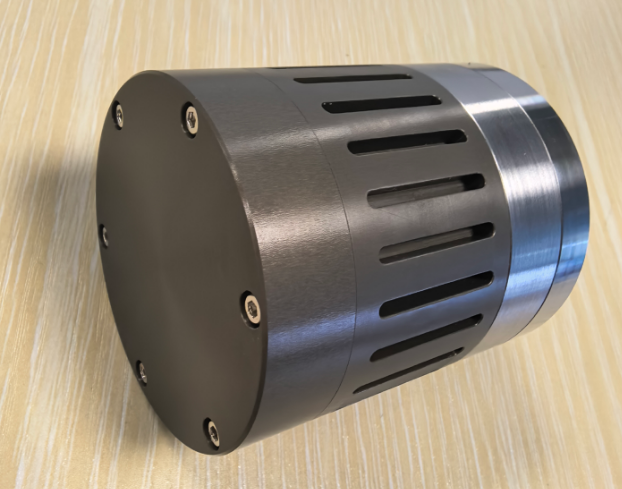
RU-JTM-60-014-CY
Compact cycloidal joint module · 27 N·m · high-impact humanoid/legged joints
View Details →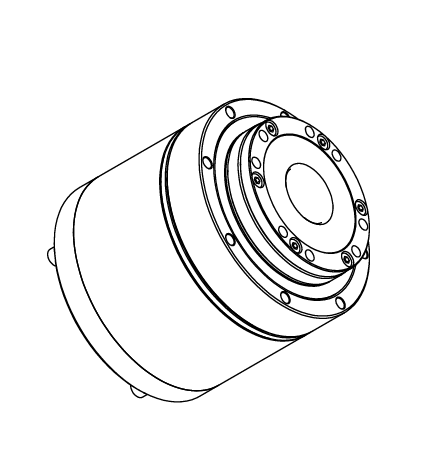
RU-JTM-70-023
Zero-backlash harmonic joint module · 31 N·m · precision collaborative arms
View Details →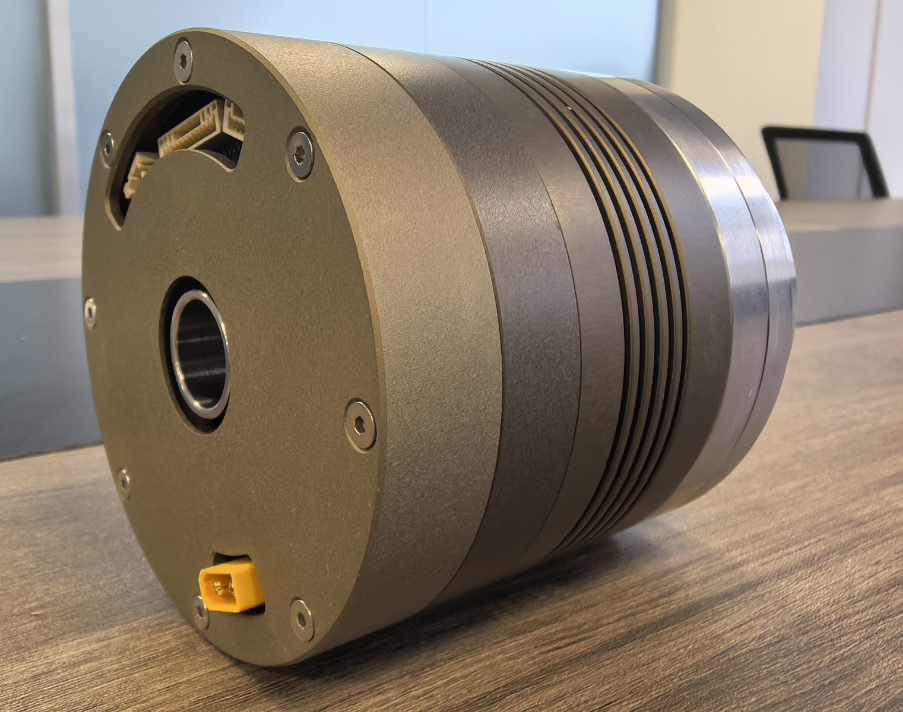
RU-JTM-80-025-CY
Cycloidal joint module · 58 N·m · high shock resistance for legged robots
View Details →