
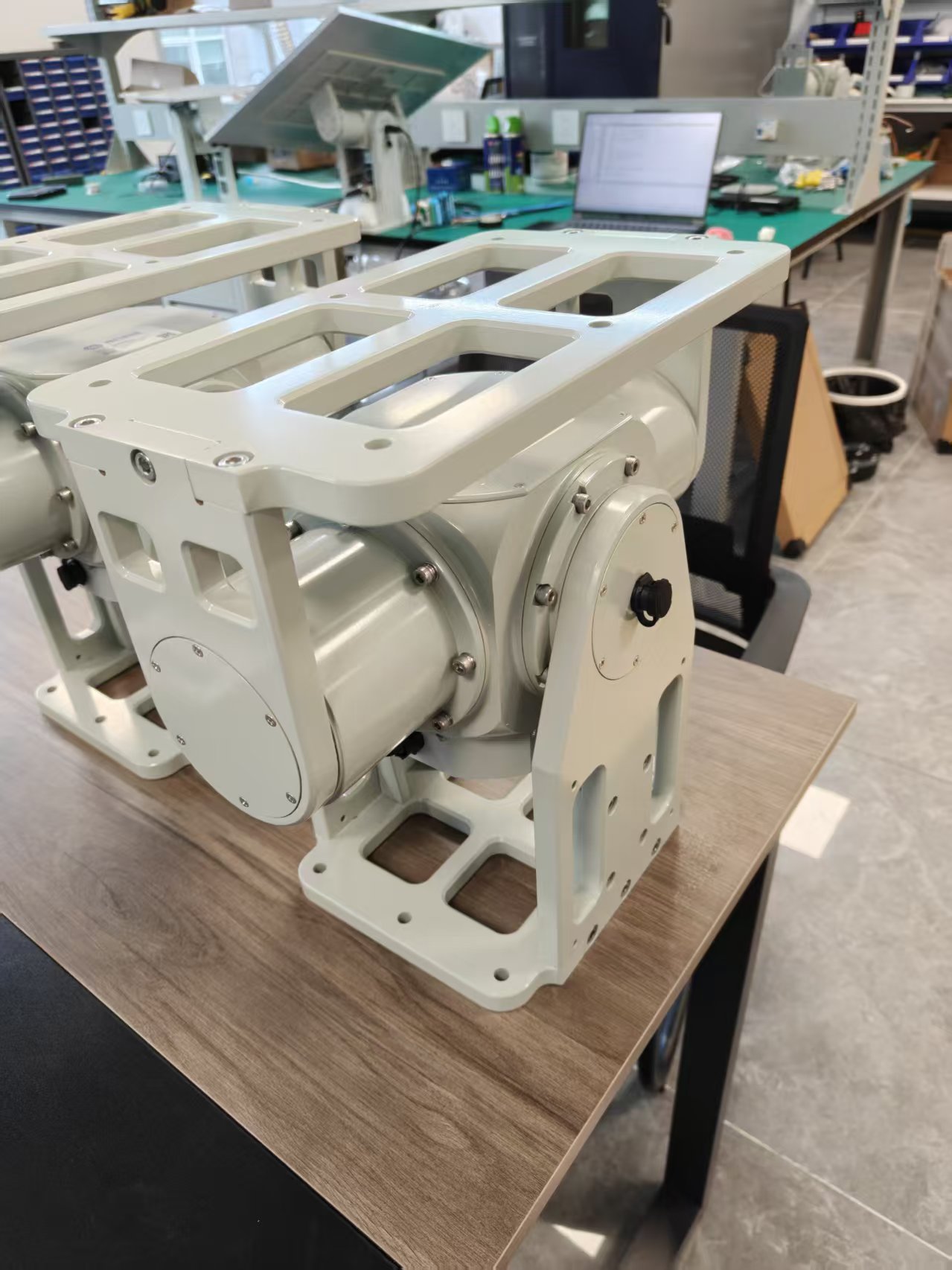
Sizing a 2-Axis Stabilized Platform: A Payload-Centered Selection Method
A payload-first selection guide for 2-axis stabilized platforms - covering sway environment, stabilization accuracy and servo bandwidth, with real parameter comparisons.
Choosing a 2-axis stabilized platform is too often reduced to a single number - "how many kilograms can it carry?" In practice, payload is only the entry ticket. A platform that holds the antenna steady through a sea state, keeps pointing error within the link margin of a Ku-band terminal, and still fits the weight and power budget of the vehicle requires matching four parameters at once: payload, sway environment, stabilization accuracy and servo bandwidth. This guide walks through each of them with real numbers.
1. Start from the payload - then derate it
Every platform has a max payload, but the number that matters is the payload at your actual center-of-gravity offset. An antenna assembly whose CG sits 50 mm off the pitch axis consumes torque capacity that a perfectly balanced load would not. A practical rule: keep the moment of inertia seen by each axis below roughly 60% of the platform's rated capability, and verify that the combined CG offset in roll and pitch stays within the manufacturer's stated envelope.
Repunite's current line illustrates the payload ladder:
| Model | Max Payload | Stabilization Accuracy | Swing Range | Weight | Supply |
|---|---|---|---|---|---|
| RU-STP-07-030 (shipborne) | 7 kg | 0.8° RMS | Roll & pitch ±30° | 5.5 kg | DC 48 V |
| RU-STP-075-035 (2-axis) | 7.5 kg | ±1° | Roll ±35° / pitch ±20° | ≤7 kg | AC 220 V |
| RU-STP-130-035 (2-axis) | 13 kg | ±1° | Roll ±35° / pitch ±20° | ≤9.2 kg | AC 220 V |
| RU-STP-25-080 (shipborne SATCOM) | 25 kg | 0.8° | Roll ±30° / pitch ±20° | ≤17 kg | AC 220 V |
| Shipborne SATCOM (high accuracy) | 15 kg | 0.3° RMS | ±30° @ 5 s period | 7.2 kg | - |
Note the pattern: doubling payload roughly doubles platform weight. If your antenna plus radome plus mounting hardware lands between two sizes, choose the larger one - running a platform at 95% of rated payload leaves no margin for ice loading, cable harness stiffness or CG drift after maintenance.
2. Match the sway environment, not the datasheet hero number
Stabilization accuracy is always quoted against a defined disturbance. A platform spec of ±1° means little until you ask: ±1° under what motion? For marine installations the reference test is typically a ±25° roll and pitch swing at a 5 s period - a moderate sea state. Repunite's 15 kg shipborne platform holds 0.3° RMS under exactly that profile, which is why it suits auto-tracking Ka/Ku terminals, whereas the 0.8-1° class platforms target broadcast and EO/IR payloads whose link budgets tolerate more pointing error.
Two practical checks before committing:
- Peak slew demand: add the vessel's worst-case angular rate to your tracking rate. If the ship yaws at 8°/s and the satellite requires 3°/s of tracking, the platform needs more than 11°/s of continuous slew on azimuth - well within the 40°/s rating of the STP series, but a real constraint for smaller gimbal-class products.
- Acceleration reserve: pointing error spikes happen during transients. Keep peak acceleration demand under half the rated value (the STP series is rated at 80°/s²) so the servo loop never saturates during a course change.
3. Don't ignore bandwidth, power and integration
The final differentiators are rarely on the first page of the datasheet:
| Consideration | What to check | Why it matters |
|---|---|---|
| Servo bandwidth | Closed-loop bandwidth vs. disturbance spectrum | A 5 s sway period concentrates energy near 0.2 Hz; the loop must have authority decades beyond it, or error grows with sea state |
| Power & supply | DC 48 V vs. AC 220 V variants | Vehicle and boat installs favor DC buses; shore and ship AC systems favor 220 V - Repunite offers both across the line |
| Weight & footprint | Platform mass vs. mast/pedestal load | The 13 kg platform is ≤9.2 kg; the 25 kg class is ≤17 kg - masts and brackets must be sized for the pair, not just the antenna |
| Feedback & interface | Encoder type, serial/Ethernet control | Auto-tracking modes need high-resolution feedback and a clean command path; verify protocol support early |
Recommended products
For compact SATCOM-on-the-move and EO/IR payloads up to 7.5 kg, the RU-STP-075-035 2-axis platform (±1°, roll ±35°, ≤7 kg, 280×67×300 mm) is the low-profile workhorse. For heavier Ku/Ka shipborne terminals in the 13-25 kg class, step up to the RU-STP-130-035 or the 25 kg RU-STP-25-080 (0.8°, 40°/s, 80°/s²). Where auto-tracking accuracy dominates - fine-tracking SATCOM, laser communication terminals - the 0.3° RMS shipborne platform is the reference choice. All three families share Repunite's integrated servo electronics, so integration effort stays with the antenna, not the stabilizer.