Specifying Servo Joint Actuators for Humanoid and Industrial Robots
Humanoid deployments such as the AEON pilot at BMW Plant Leipzig put factory-duty requirements on every joint actuator. A practical selection framework: torque-density-first sizing, thermal duty cycles, and feedback architecture - with real parameter tables mapped to Repunite RU-JTM joint modules and MIL-grade servo drives.
Start From the Joint, Not the Robot
When a humanoid robot steps onto a factory floor - as the AEON from Hexagon Robotics now has at BMW Plant Leipzig - the load profile of each joint stops being a research question and becomes a duty-cycle specification. A production humanoid typically carries 25 to 40 actuated joints. Hip, knee, and shoulder joints see the highest continuous torque; wrists and ankles trade torque for speed and compactness. IDTechEx estimates that actuators account for roughly 56% of a humanoid total weight, which is why every gram of gearbox and motor housing is scrutinized during selection.
The practical mistake is sizing from peak torque alone. A joint that must lift 8 kg at 0.9 m reach needs about 72 N-m of static torque before dynamics - but the actuator also has to absorb landing impacts, hold position against gravity during pauses, and do it thousands of times per shift. A sound workflow: compute continuous RMS torque from the full motion cycle, add a 1.5x dynamic margin, then verify the reducer permitted peak torque and the drive overload curve at the duty point.
| Joint class | Typical continuous torque | Reducer choice | Backlash target |
|---|---|---|---|
| Wrist / ankle | 10 - 55 N-m | Harmonic | < 20 arcsec |
| Elbow / mid-arm | 50 - 120 N-m | Harmonic or cycloidal | < 10 arcmin |
| Hip / knee / shoulder | 150 - 420 N-m | Cycloidal pin-wheel | < 10 arcmin |
Thermal Duty and the Case for Integration
Factory humanoids run far harder than demo units. Continuous material handling means the motor rarely returns to ambient temperature between cycles, so winding temperature rise - not torque rating - is usually the binding constraint. Frameless torque motors with high pole counts (12 to 14 pole pairs is typical) deliver the torque density, but they need drives that can manage 2x to 3x overload events without tripping and without cooking the windings.
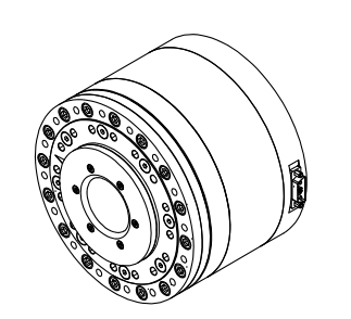
This is where integrated joint modules earn their place. A module that packages the frameless motor, reducer, encoder, and servo drive into one sealed housing eliminates the harness, connector count, and tuning drift that come from mixing vendors. Fewer interfaces also mean better IP performance and faster assembly - one control connector per axis instead of five.
| Repunite model | Rated power | Rated / peak torque | Reducer | Operating temp |
|---|---|---|---|---|
| RU-JTM-90-282 | 282 W | 54 N-m rated, 1:100 harmonic | Harmonic, <20 arcsec | Standard |
| RU-JTM-50-066 | 660 W | 50 N-m rated / 150 N-m peak | Cycloidal, 1:25 | -40 to +65°C |
| RU-JTM-100-040 | 400 W | Hollow-shaft, 400 W class | Harmonic, large bore | Standard |
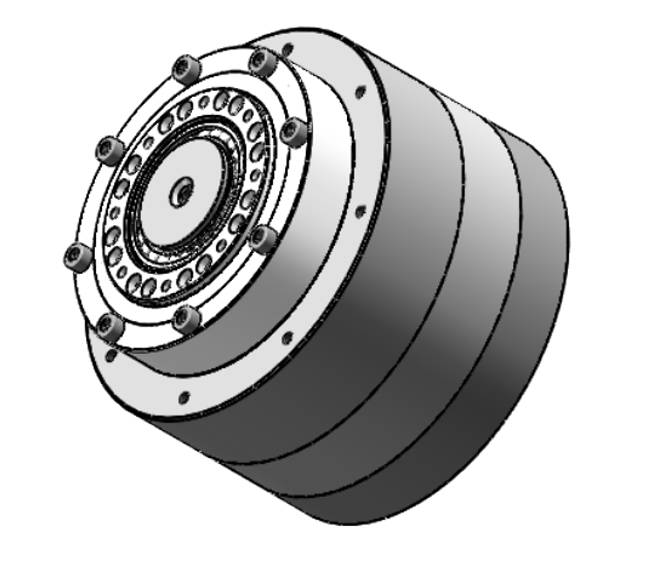
| RU-JTM-147-160 | 1,600 W | 418 N-m rated / 1,000 N-m peak | Cycloidal pin-wheel | -40 to +55°C |
For hips and knees, the RU-JTM-147-160 is the reference choice: 418 N-m continuous from a 48 V DC bus, 1,000 N-m peak for gait impact events, and an inductive encoder for position feedback that tolerates dust and vibration. For wrists and lighter arms, the 282 W and 660 W classes keep mass down where the lever arm is short.
Drives, Feedback, and Fieldbus: Closing the Loop
The joint is only as good as its drive electronics. In plants, EMI from welders and VFDs is aggressive, so the drive needs robust position feedback (resolver or inductive encoder rather than bare incremental optics) and a fieldbus that is standard in factory automation. CANopen remains the pragmatic choice for joint-level control inside a humanoid, with RS485 for diagnostics and configuration.
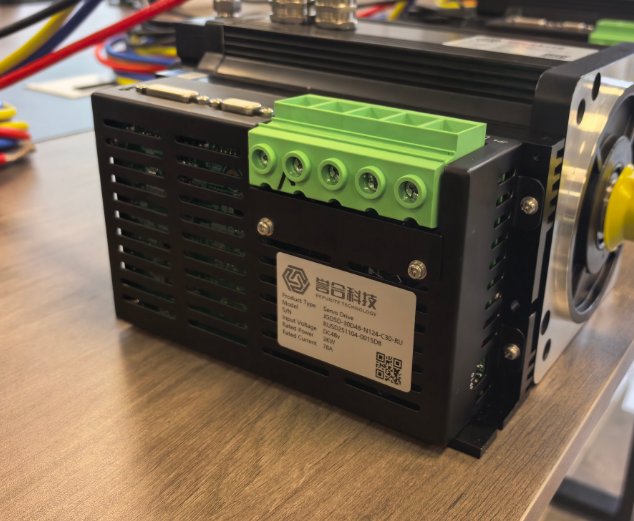
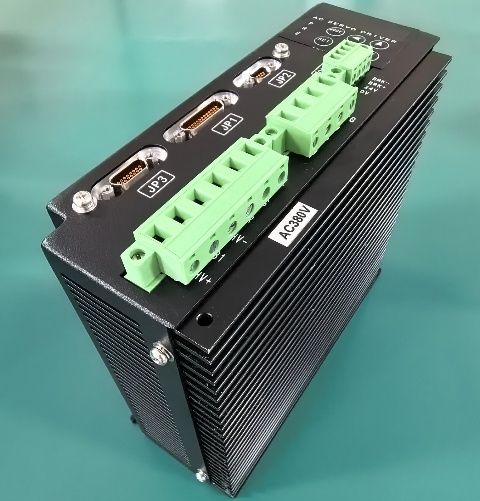
Where the robot builder prefers to source drives separately from the mechanical module, the Repunite JGASD and JGDSD servo drive families close the loop. Both are built for exactly the environment a plant humanoid lives in:
- JGASD 1 kW AC servo drive - 3x overload, resolver decoding on board, RS232 / RS485 / CANopen, -40 to +85°C
- JGDSD 3 kW 48 V DC servo drive - 3x overload, DSP + IGBT power stage, -40 to +85°C, CANopen native
A 48 V DC bus is the emerging standard for mobile humanoids because it matches battery stacks directly and stays inside low-voltage safety limits. Pairing a 48 V drive like the JGDSD with the RU-JTM-147-160 (DC 48 V rated) gives a single-battery-voltage joint axis with no intermediate conversion stage - fewer failure points, and one less thermal source inside the torso.
If you are specifying actuators for a humanoid, quadruped, or heavy articulated arm and want a second opinion on joint sizing, talk to our engineering team - we provide duty-cycle based selections, not just datasheet matches.

RU-JTM-147-160
1.6 kW integrated joint module, cycloidal reducer, 418 N-m rated torque, DC 48 V.
View details