
High-Power-Density Servo Drives for UAV Propulsion and Unmanned Platforms: An Engineering Selection Guide
The AIR-Elmo partnership shows why drive efficiency and power density decide payload, range, and endurance in electric aviation. This guide explains how to evaluate servo drives and joint modules for unmanned systems, with comparison tables of representative specifications.
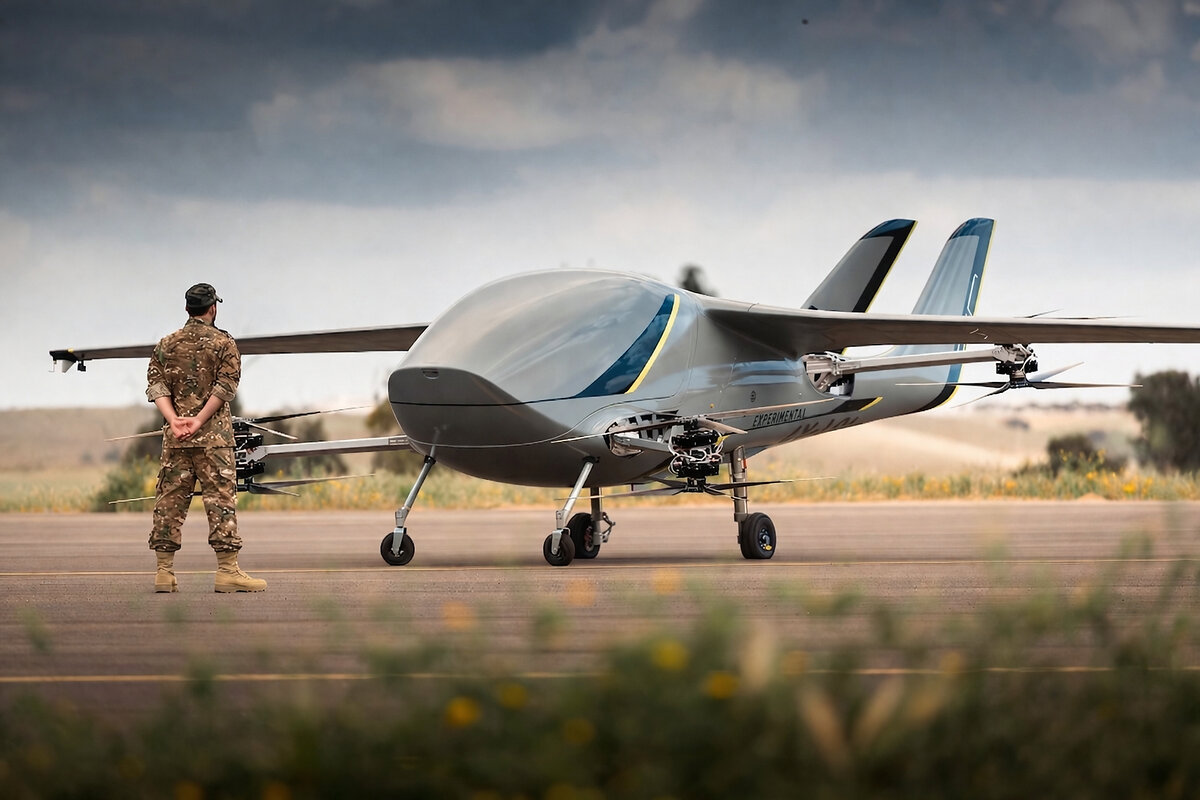
The 2026 wave of electric aviation partnerships has made one thing explicit: in unmanned aircraft and ground vehicles, the servo drive is no longer a commodity component. When AIR selected Elmo's Gold HV drives to power the eight electric propulsion motors of its 550 lb-payload VTOL cargo UAV, the decisive factor was efficiency — high enough to eliminate liquid cooling entirely, shedding weight and complexity while raising payload capacity. This article lays out a practical selection framework for engineers specifying servo drives and joint modules for UAVs, UGVs, and stabilized-platform payloads.
1. Why Power Density Decides the Mission Profile
For an electric aircraft, every watt lost in the drive stage becomes heat that must be carried away — by heatsinks, fans, or coolant loops, all of which add mass. Drive efficiency therefore converts directly into mission performance:
- Thermal chain rule: at 95% efficiency a 2.8 kW drive dissipates 140 W; at 90% it dissipates 280 W — double the cooling burden for the same output.
- Altitude derating: air density falls roughly 1% per 100 m of climb, so convection cooling weakens precisely where UAVs operate. Drives rated for wide temperature ranges (-40 °C to +85 °C) keep delivering without liquid cooling.
- SWaP budget: compact, high-power-density drives free volume for batteries and payload. In multi-motor platforms (eight propulsion units in AIR's case), a few hundred grams saved per drive compounds into kilograms.
The same logic applies on the ground. A joint module or gimbal drive with poor part-load efficiency drains batteries during the hover-hold or track-hold phases that dominate most unmanned missions — phases where the platform is barely moving but consuming continuously.
2. Selection Criteria Beyond the Datasheet Headline
Peak current and peak torque dominate marketing sheets, but sustained operation is what sizes the thermal design. We recommend evaluating candidates against six criteria:
| Criterion | What to check | Typical target (unmanned platforms) |
|---|---|---|
| Continuous vs peak current | Continuous rating at realistic ambient, not 25 °C lab conditions | Continuous ≥ 33% of peak for repeated duty cycles |
| Operating temperature range | Fully specified low-temperature start and high-ambient dissipation | -40 °C to +85 °C without derating conversation |
| Feedback options | Resolver / absolute encoder support, noise immunity | Resolver or multi-turn absolute (BISS, Tamagawa); incremental as fallback |
| Fieldbus & integration | CANopen / EtherCAT, real-time monitoring channels | CAN or EtherCAT; 10+ real-time monitoring items |
| Protection functions | Overcurrent, overvoltage, undervoltage, overheating, overspeed | Full set with built-in regeneration resistor |
| Power density | kW per liter and per kg including cooling provisions | Compare system mass: drive + cooling + wiring |
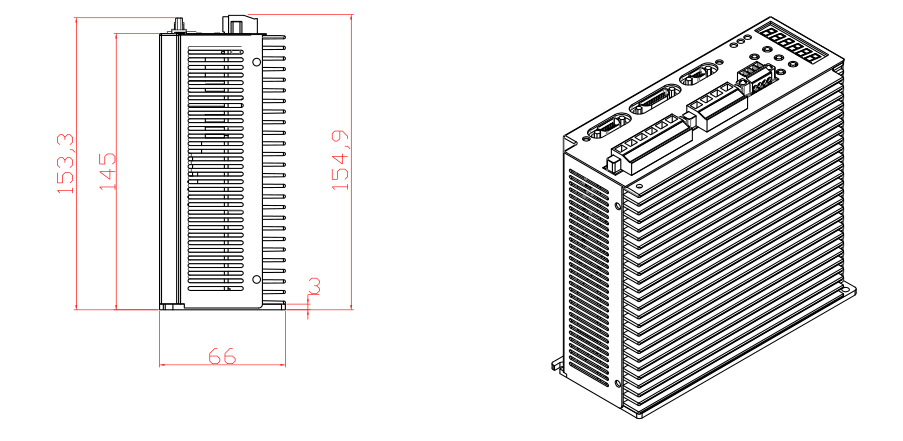
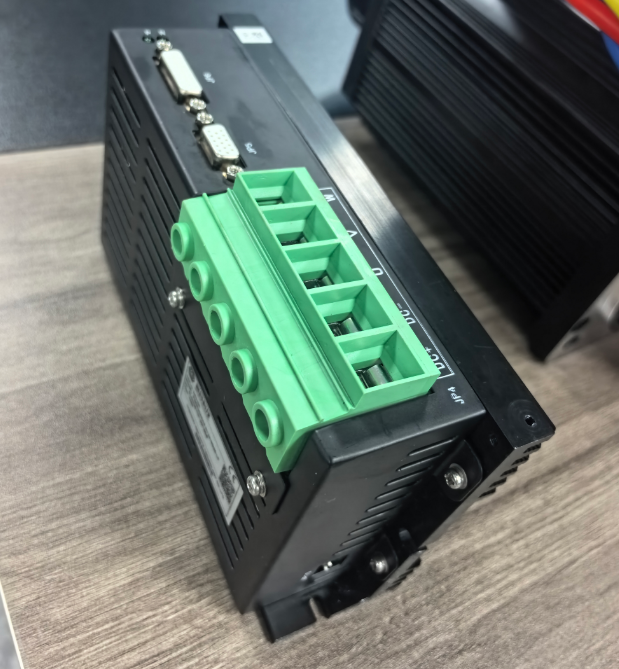
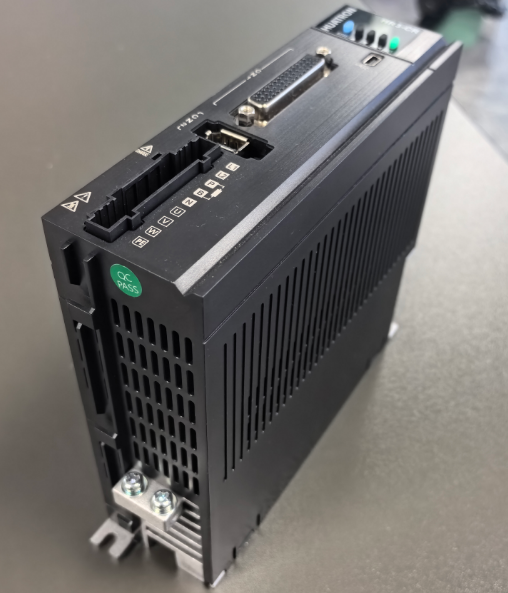
As a concrete reference point, the JGASD-28A38 MIL-grade AC servo drive is rated 2.8 kW with 7.5 A continuous / 22.5 A peak current, accepts AC 380 V or DC 600 V input, supports resolver and multi-turn absolute feedback (BISS, Tamagawa) plus incremental, communicates over RS232/RS485/CAN/CANopen, provides 14 real-time monitoring items, and integrates a built-in regeneration resistor — specified across -40 °C to +85 °C with natural or fan cooling.
3. From Drive Selection to Integrated Joint Modules
Once the drive stage is settled, most unmanned-platform teams face a second decision: build the joint from discrete motor + reducer + encoder + drive, or adopt a factory-integrated joint module. Integration removes the cabling, alignment, and tuning burden at assembly, and lets the vendor co-optimize the thermal path — the same reasoning that led the AIR platform to a single-vendor propulsion-drive architecture.
Representative specifications from one such integrated family:
| Model | Rated power | Torque | Rated speed | Gear ratio | Backlash | Weight |
|---|---|---|---|---|---|---|
| JTM-90-282 | 282 W | 54 N·m | 30 rpm | 1:100 | < 20 arcsec | 1.5 kg |
| JTM-120-150 | 1.5 kW (peak 4.5 kW) | 102 N·m cont. / 418 N·m peak | 135 rpm | 1:18 | — | 3.0 kg |
The JTM-90-282, for example, integrates a frameless torque motor, reducer (1:100, <20 arcsec backlash), dual 24-bit absolute encoders, and the servo drive in a 1.5 kg, 48 V package with CAN connectivity — a complete replacement for a four-component discrete stack. At the heavier end, the JTM-120-150 delivers 418 N·m peak torque at 72 V with EtherCAT, suiting leg joints and manipulator shoulders.
Recommendation. For propulsion-adjacent and high-dynamic duty, prioritize drive efficiency and continuous-current honesty over peak figures, and verify the full-temperature specification in writing. For joints and gimbal axes, integrated joint modules cut integration risk substantially. Review the Repunite product range — JTM-series integrated joint modules, JGASD-family MIL-grade servo drives, and M2-series industrial servo motors (e.g., M2H080-S75, 750 W, 3000 rpm, 23-bit absolute feedback, IP65) — and contact us with your duty-cycle profile for a sizing review.
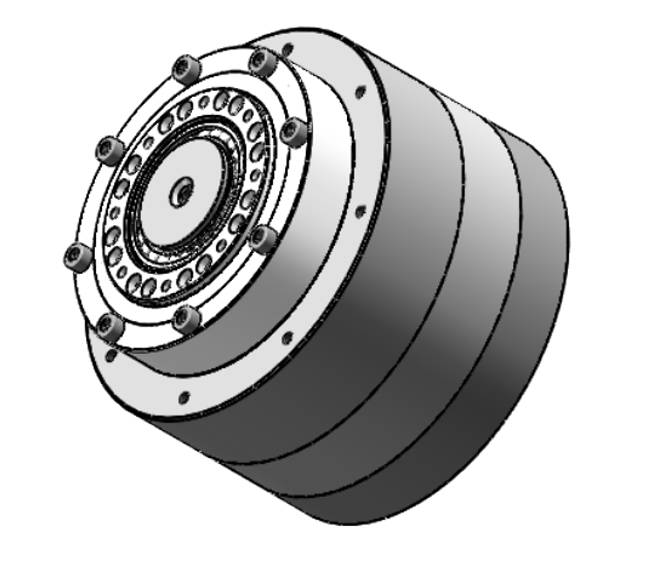
RU-JTM-90-282 Joint Module
48V/282W integrated joint module · peak 24.5A · for UAV & unmanned payloads
View Details →