
Sizing the Servo Drive: Current, Bus Voltage and Regeneration for Antenna Positioner Axes
A practical sizing walkthrough for antenna pedestal servo drives: how to convert load torque into RMS and peak current, when to stay on a 48 V bus versus a 310 V bus, and how to budget regenerative braking energy so the positioner never trips on overvoltage.
1. Start from RMS and peak current, not from rated power
Torque maps to current through the torque constant Kt, so the drive must cover two distinct numbers: the RMS current of the duty cycle and the short-duration peak. Sizing on nameplate power alone is the classic mistake, because a pedestal axis has high static wind torque at low speed and short acceleration bursts that are invisible in an average-power calculation.
Worked example: a 0.9 m Ku-band antenna on a direct-drive azimuth axis.
| Quantity | Value | Notes |
|---|---|---|
| Torque constant Kt | 1.2 N·m/A | Frameless torque motor, direct drive |
| Continuous load torque (wind + friction) | 7.2 N·m | RMS duty → 6.0 A continuous current |
| Peak torque (slew acceleration + gust) | 24 N·m | 20 A, limited to ≤ 3 s |
| Max slew rate | 60 rpm | Full link repositioning |
| Drive requirement | ≥ 10 A cont. / ≥ 20 A peak, 48 V bus | Select next frame up for margin |
Two margins matter: peak current derates with ambient temperature and with DC bus droop, and continuous current depends on the heatsink, not the semiconductor. A drive rated 10 A on a cold plate may deliver only 6 to 7 A in a sealed pedestal enclosure at 55 °C.
2. Bus voltage: stay at 48 V or go to 310 V
Back-EMF sets the floor. At 60 rpm with Ke = 0.35 V/rpm, the motor generates about 21 V; adding cable drop, drive deadtime losses and a 20 percent margin lands comfortably inside a 48 V bus. Above roughly 200 rpm, or wherever the platform already distributes 220 V AC, a 310 V DC bus (rectified mains) cuts phase current by a factor of six for the same power and keeps long motor cables manageable.
| Aspect | 48 V DC bus | 310 V DC bus |
|---|---|---|
| Insulation and safety | SELV range, simple field wiring | Hazardous voltage, creepage and clearance design required |
| Motor cable length | Tens of meters practical | Hundreds of meters feasible |
| Ruggedized drive options | Wide, including wide-temperature and shock-rated units | Mostly industrial cabinet formats |
| Typical platforms | Vehicles, battery-powered pedestals, man-portable terminals | Fixed ground stations, large radars |
3. Budget the regeneration energy before it trips the drive
Every deceleration returns kinetic energy to the bus: E = 0.5 · J · ω². With 3.0 kg·m² of inertia reflected at the motor and a 60 rpm slew (6.28 rad/s), each stop returns about 59 J. Bus capacitors absorb a fraction; the rest must be burned in a shunt resistor, and repeated slewing turns that into real average power.
| Parameter | Value |
|---|---|
| Reflected inertia J | 3.0 kg·m² |
| Deceleration speed | 6.28 rad/s (60 rpm) |
| Energy per stop | ≈ 59 J |
| Stops per minute | 6 |
| Average regen power | ≈ 6 W, with 59 J pulses → specify resistor ≥ 100 W with pulse rating |
Before ordering, verify: peak and continuous current at the real ambient temperature, bus voltage at maximum back-EMF plus margin, regen resistor pulse rating for the duty cycle, IP and temperature rating for outdoor pedestals, and feedback compatibility (resolver or absolute encoder) between motor and drive.
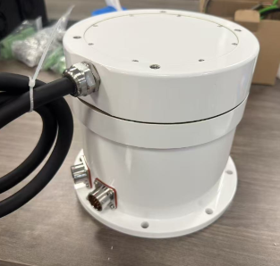
For azimuth positioners we typically ship the RU-SF direct-drive servo turntable family with an integrated 48 V drive, the JGDSD series ruggedized drives for low-temperature and shock environments, and the M2 80 mm 750 W servo motor for geared axes. All three are available with CANopen or EtherCAT control interfaces.

Single-Axis Azimuth Servo Turntable 40 · Direct Drive
Integrated motor, encoder, drive and controller for search and tracking antennas
View details →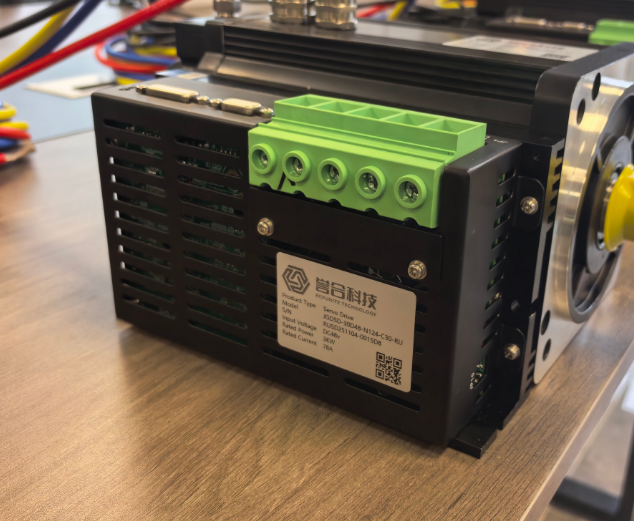
JGDSD 3kW 48V DC Ruggedized Servo Drive
DSP + IGBT power stage for low temperature, vibration and shock environments
View details →
M2 80mm 750W Industrial Servo Motor
750W / 2.4N·m, 3x overload, multi-turn 23-bit absolute encoder, IP65
View details →